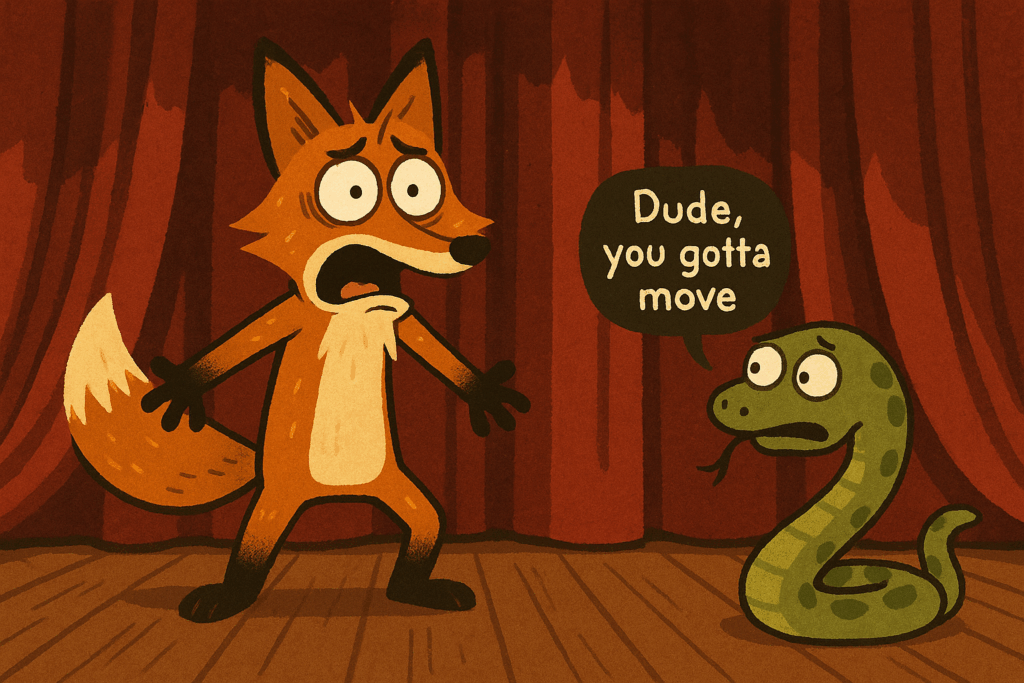
The improv stage is the ultimate blank slate. An empty void screaming for a world to be built on it. That world comes from the gifting of an invisible object or space, eg ‘this broom is yellow and laying on the floor’, and then treating that reality as 100% true for the entire scene. Think of it like a shared delusion that sets your scene partner and the audience free. Let’s learn how to build a cool world.
1. Define It
When you touch that door handle, that remote control, or that ancient book, it’s your job to make a choice. Don’t ask your scene partner what you just touched. You know it.
Everyone wants to know if the broom is light or heavy. Why is it there? Is it made of wood? Does it look old or new and expensive?
Now that we all know that about the broom, the way you interact with it can only be under that description. If it’s heavy, surely you’ll groan by picking it up. If it’s old, you might complain that you need a new one that doesn’t look so decrepit.
2. Engaging the Five Senses
We are not just using our eyes. Strong worlds use all five senses.
-
Smell: Is the air thick with the metallic scent of a fish market, or the faint, sweet smell of baby powder? Sniff the air.
-
Texture: Don’t just sit; feel the scratchy, moth-eaten wool or the icy, smooth leather. Lick the rain off your finger.
-
Sound: Give the floorboards a specific creak. Give the object a specific weight that makes your shoulders hunch.
Now your scene partner can react to the smoke you smell or the cold floor you felt.
3. Don’t go against the world
Your invented world is not fluid. The audience and your partner rely on you to be the constant explorer of this invented space.
-
Spatial logic: If the fireplace is to the right and the staircase is to the left, they stay there. If you have to step over a sleeping dog, that dog is still there 30 seconds later.
-
Travel time: If you walk off stage right (into the garden) and return from stage left, you must have traveled a consistent, believable distance. Take the time! Don’t just pop back in. The journey must match the geography.
-
Payoff: When you maintain perfect geography, you give your partner the freedom to react genuinely to the world you built.
Poor worlds create confusion
The casual, non-committal wave at an object forces the audience to constantly ask, “Wait, what is he doing?”, and you’ve lost them then.
Strong, detailed worlds:
-
Anchors the scene and focuses the audience.
-
Gives the characters endless reasons for physical action.
-
Eliminates the audience’s guessing, allowing them to focus 100% on the character development.
Build your world right, and everyone gets to live in it!
Tell us below that you’d like to join this tutorial*
*if you leave the text field blank, we won’t know what you want to join.